


The genius of the dialogue is that it is a form of play. With a dialogue, you’re at liberty to explore ideas you disagree with. If you like what you find below, please consider becoming a free or paid subscriber.
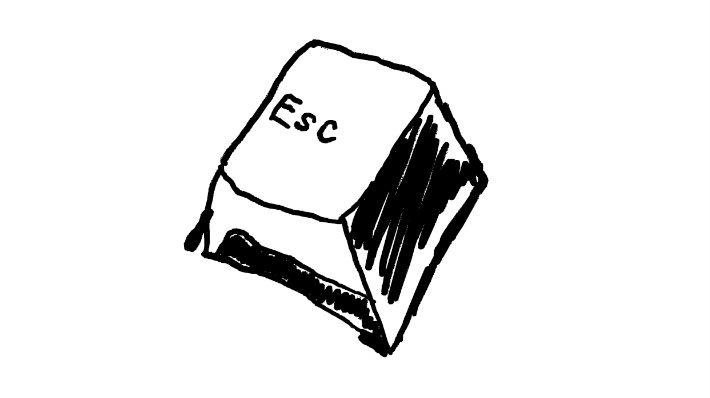
Nine out of ten people can’t recognize their own hands in a photograph.1
It seems that we take our hands for granted. They are (in the words of Corey Anton, I believe) “haptic intentionalities” through which we attend to the world. Our hands fall into the taken-for-grantedness of things. But they’re always there, helping us accomplish our ends, facilitating our projects like good servants. If idle hands are the devil’s playground, it is because idle hands mean idle minds and idle bodies.
Unless you work in a skilled trade, your hands most likely rest (and occasionally twitch) on keyboards—whether on your computer or on your smartphone. The word “manual,” a quaint word nowadays, as in “manual labor” or “manual transmission,” comes from the Latin manus, which means “hand.” To “manufacture” is literally to make by hand. Of course, manufacturing nowadays means anything but.
In what follows, a keyboard and a pen (or pencil, if your imagination prefers) each make some claims as to where you should put your hands the next time you want to write something down, especially if you hope to compose more thoughtful, creative, or intellectual prose.
One effect of this exercise is to demonstrate that technologies already make arguments for their use (or disuse). I don’t just give voices to the keyboard and pen in what follows. These technologies already say something, even though they speak in hushed or inaudible tones.
A Dialogue Between a Keyboard and a Pen
Keyboard (henceforth, simply “K”): Writing articles, books, and essays by hand takes an eternity. You go off into your little corner with your pen and yellow legal pad. But how many words do you write? Do you even know? No, you probably don’t, because you can’t see the word count grow in real time. So you delude yourself into thinking you’re being productive. But here’s my favorite part: After you spend an eternity drafting by hand, you have to go and type it all up into a computer! You have to use me, anyway! You just delay the inevitable, and you trick yourself into thinking you’re doing deeper, better, more meaningful work. Don’t you know there’s no end to your craftiness in deceiving yourself? All you’re doing when you write by hand is slowing yourself down from creating a finished product. My younger brother—the Large Language Model—doesn’t even need me to generate text (well, not really). Even though he steals a lot of my business (and I am oriented towards business, mind you), I don’t really mind. I have to respect his sheer efficiency. What would take you an hour or more by hand, he can do in one second. Or less! To use his services, you still need me to generate prompts, of course. Are you still with me?
Pen (henceforth “P”): I am.
K: Good. And I speak not just to you but to those in the audience here who aspire to authorship. Now let me continue. Even if you do draft by hand, I bet you’ve thought of photographing your work and using my brother to convert that image into some digital text. Why do you have this irrational fear of using me? Just use me first, good people. Let go of your pen. Save your hand the pain of cramping.
P: I must confess before beginning that I’m quite old and easily winded. I’m something you have to carry, like Anchises on the back of Aeneas. I’m not something to rest on.
K: How old are you now?
P: I imagine I have some ancestors dating back to Sumer.
K: And their carving in mud?
P: Clay or mud. I’m not sure which.
K: And you’ve done business with Homer?
P: If you want to call it that—Homer or his scribe.
K: And Herodotus?
P: Everyone—from Shakespeare to Montaigne to Paine. Until you came along.
K: Well, you can see me in the telegraph and typewriter, what with their tapping and clacking.
P: Nietzsche was on to you and your ways.
K: He was. Perhaps I drove him mad. I do abhor silence. I loathe your austerity and asceticism and slowness. Goodness me. I dream of seeds of thought that sprout and shoot at the pop of a key—not those that creep and crawl from their ink-stained graves in slow motion.
P: But you cannot doodle?
K: Cannot doodle?
P: In the margin, I say. You cannot play in the margin.
K: I have no desire to play in the margin. I open up more ecstatic forms of play.
P: I’ve seen you’ve been colorful, as of late. When you’re stuck on to a gaming computer, you glow like a rainbow.
K: I find it distasteful, but what can you do.
P: Must be tough for someone so bent on the analytic, quantifiable, and left-brained.
K: Left-brained? Ha! Me? I am the corpus callosum, what McLuhan prophesied as necessary. I use both hands and therefore both hemispheric regions of the brain, dear friend. It’s you, and you alone, who have singlehandedly separated the master from his emissary.
P: That is a wild and verbose accusation.
K: As if I could help myself. I agitate for symmetry and order. But you are as dead as lead. At high noon, I draw quicker.
P: If I am slow (to speak), it’s because I must be quick (to listen). I must have the end in mind before I open my mouth or let the ink spill. A pen must therefore be Aristotelian for this very reason. With me, you can feel the magnetic curve of form pulling you through your work. But you, you jump around too much. You don’t glide but punch and hammer. You make writing war. You know no curves. You are but random points scattered in a coordinate plane (a board of keys). You are diffuse, my friend, and from your diffusion comes confusion. You are endless promises and nothing but.
K: Let us make one more appeal to our patient audience, shall we?
P: You first.
K: Dear esteemed reader, you who are bombarded by emails, you who must write for a living, both ye creative and non-creative types, I present myself to you as the standard bearer of good thinking, of the efficient production of prose. You are free to write by hand, if you wish. You know it. But know this. You write by hand as a luxury. As a diversion. As a way of deceiving yourself into thinking you’re writing more authentic prose. You’re free to drink espresso and wear your Steve Zissou hat as some fringe indie band nobody has ever heard of plays in the background. Go ahead and jot in your Moleskine. But know ye this: You will produce less. It is not complicated. The slower you write, the less you can write in any given period. We’re not at a juncture in history where we need to re-think the wheel here. I am the future. I have been the future since the early 1990s. The most important thing you ever get, after the alphabet, is me (and I have the alphabet for a face). Educators will not (and should not) cease teaching students to type. It is their entrance into the world of commerce. Of business. Of the real world, which is the virtual world. But the real world, nevertheless. Dear Pen, you are but a waystation, something easily bypassed. Not so with me.
P: Are you done?
K: I am.
P: Good. You have a choice, reader: The keys or me. I only offer you pain: slow, measured words, carefully weighed. Look at my opponent. See him chained. He is bound to a monitor, always a monitor, always a screen with him. You are forever before the glow of something, most likely a company or program or application. I say again: See him chained! Will you not be chained with him if you use him? With him, your brain will forever be for rent, your eyeballs leased to the highest bidder. But with me, I am under the dominion of no plastic or glass. I yearn only to sit between paper and hand. Paper that may burn or tear. Hand that may break or bleed. I built Rome—not Silicon Valley. I offer you a signature experience—not the uniform and gray. No monitor means no temptation to browse, no social media, no distraction. I can give you poetry, even in prose. But there never has been and never will be a “keybard.”
K: Oh, what terrible slop you produce. I have aided many a bard. I could make poetry from your jugular!
At this, their quibble broke into a brawl. The pen drew first blood, scribbling on the keyboard who was chained to a computer and could not break free. The keyboard spit out several keys after taking heavy blows, the keys falling like teeth from a dragon’s mouth.
Yet the keyboard enlisted his friends, monitor and desktop tower included, to beat that pen into a papery pulp. The pen’s last words before dying were: “By my cold dead hand!”
Drew Leder, The Absent Body, p. 1
To the keyboard I say, "I may be able to produce more words by volume by using you, but the Pen requires thought, and thoughtful writing is of an objectively higher quality. Quality over quantity, Keyboard."
A nice pen makes writing a joy. No keyboard, not even the nicest mechanical model, can replace the feeling of a pen gliding across a sheet of paper. Nor can a keyboard truly capture the breadth of emotion that a pen can present. Soft, flowing penmanship speaks joy, love, and peace, while hard, angular letters betray anger, grief, and frustration.