

Aquinas and the Black Box: A Short Quiz
Some say Aquinas would have used AI. I made a short quiz to determine whether they’re right.

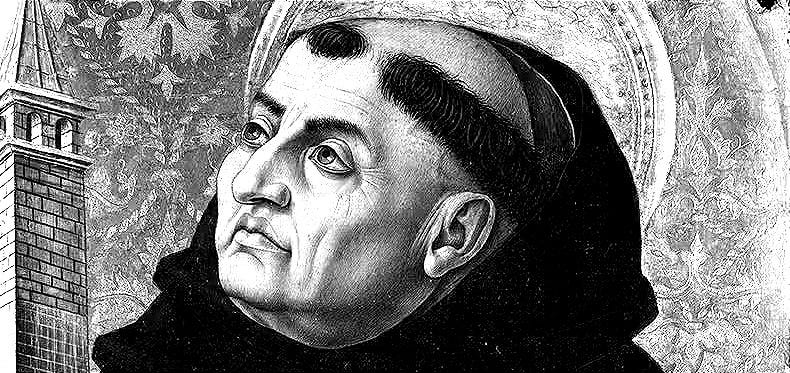
I’ve been told that a Catholic entrepreneur and AI evangelist has argued that St. Thomas Aquinas would have used artificial intelligence. Therefore, I structure this quiz around that contention.
#1
Question: Would St. Thomas Aquinas have used AI?
Select the best answer.
A) Yes. For starters, it would have dispensed with the need for all those pesky memory palaces. Further, he would’ve been able to get rid of his lazy scribe, Reginald, who had been a major pain since day one, always complaining about the food and the stench of his cell. It is easy to imagine the Dumb Ox sitting there in his stone oasis, all alone before his glowing screen, chicken pecking the prompts that would eventually become the extraordinary Summa Theologiae (or Pange Lingua).
B) No, he wouldn’t have. He didn’t even write for himself. He dictated to Reginald (see above). It’s not only that he wouldn’t have used AI. He wouldn’t have used a computer, word processor, pen, pencil, or even paper for himself. He had a dialectical cast of mind, which was at first a dialogical mind. Thinking was an ars disserendi, an art that occurred through one’s own speech in relation to a living interlocutor. Do you mean to tell me that Reginald never stopped him to say that wasn’t making any sense? And you mean to tell me that our sycophantic, commercially driven AI platforms would have interrupted him mid sentence to put him back on track? Maybe, you say. But Aquinas would never have used AI for the same reason he would never have had a LinkedIn profile. He would’ve sniffed out the commercial interests at play from square one.
C) It is impossible to know, so stop co-opting Aquinas to sell your software as a service.
D) It is reasonable to think he would. You stop co-opting Aquinas for your head-in-the-sand tech pessimism.
E) Calm down. Aquinas would have used AI for some things and not for others. AI is a neutral tool, and all that matters is how you use it. For example, he would’ve used AI to summarize Aristotle’s Organon (as we all know, it is much too long and much too dry). He would’ve used it to translate Avicenna’s commentary on the Stagirite from Arabic to Latin. He would’ve used AI to prepare his taxes, create silly memes, and find recipes for special avocado dip to serve at the annual University of Paris faculty potluck. But he would never have used it to actually compose his texts, for Aquinas would have been tuned in to how the means of composition always affect the composition itself.
F) None of the above.
#2
Thought Experiment
Imagine St. Paul can travel through time. He’s there in modern day Antioch, but he still needs to contact the budding church in Rome. Does he dictate a handwritten letter to them telling them he’s coming? Does he send them an email? Does he facetime them? Presupposing he does the last, does he still even need to go visit them in person? In the flesh? Explain your answer.
#3
Put a checkmark next to all of the following statements that are true:
Gerard Manley Hopkins would have used AI to write his poetry.
Gerard Manley Hopkins would have used AI to find ideas for his poetry, but not to actually write it.
Dante would have used AI as his guide through Hell instead of Virgil.
The Devil himself, an angel of light, would have used AI to flatter Adam and Eve into thinking they could know everything and therefore do anything they wanted. “And ye shall be as gods….”
#4
Essay Questions
Choose one of the questions below and respond to it completely in full sentences.
A) Pick one of the following technologies and describe what effect (if any) it would have had on the community life at the University of Paris in the 13th century: email, printers, HVAC, whiteboards, the modern grading system (As, Bs, Cs, etc.), learning management systems (Blackboard, Canvas, etc.).
B) Explain, briefly, what the students at the University of Paris would have thought about the idea that the point of going to school is to acquire a prestigious credential that enables you to get a high-paying job (or any job at all, for that matter). Further, explain whether these students, if transported to our current historical moment, would demand training in AI. Describe the ends or purpose to which these students would apply AI.
C) Explain what Aristotle taught about the Delphian knife. Compare the Delphian knife to at least one technology in use today. To get the maximum number of points, you must use the terms “exchange value” and “use value” in your reply. For bonus points, compare it to ten or more technologies and explain what all of these artifacts have in common.
D) Explain what the terms “imprimatur” and “nihil obstat” mean. Where would you find these terms originally? Look up what “black box” means in the context of technology, especially with regard to AI results/output. Can you put a digital imprimatur or nihil obstat on a black box? And would answering this question give us any better indication of whether St. Thomas Aquinas would have used AI?
Justin Bonanno is an Assistant Professor with interests in rhetoric and artificial intelligence. His favorite sort of quiz is the one that provokes but that doesn’t need graded.