

How to Go Back to the Land, Catholic Edition: A Book Review of Liturgy of the Land
For those who want to “touch grass,” dig it up, and plant something in its place

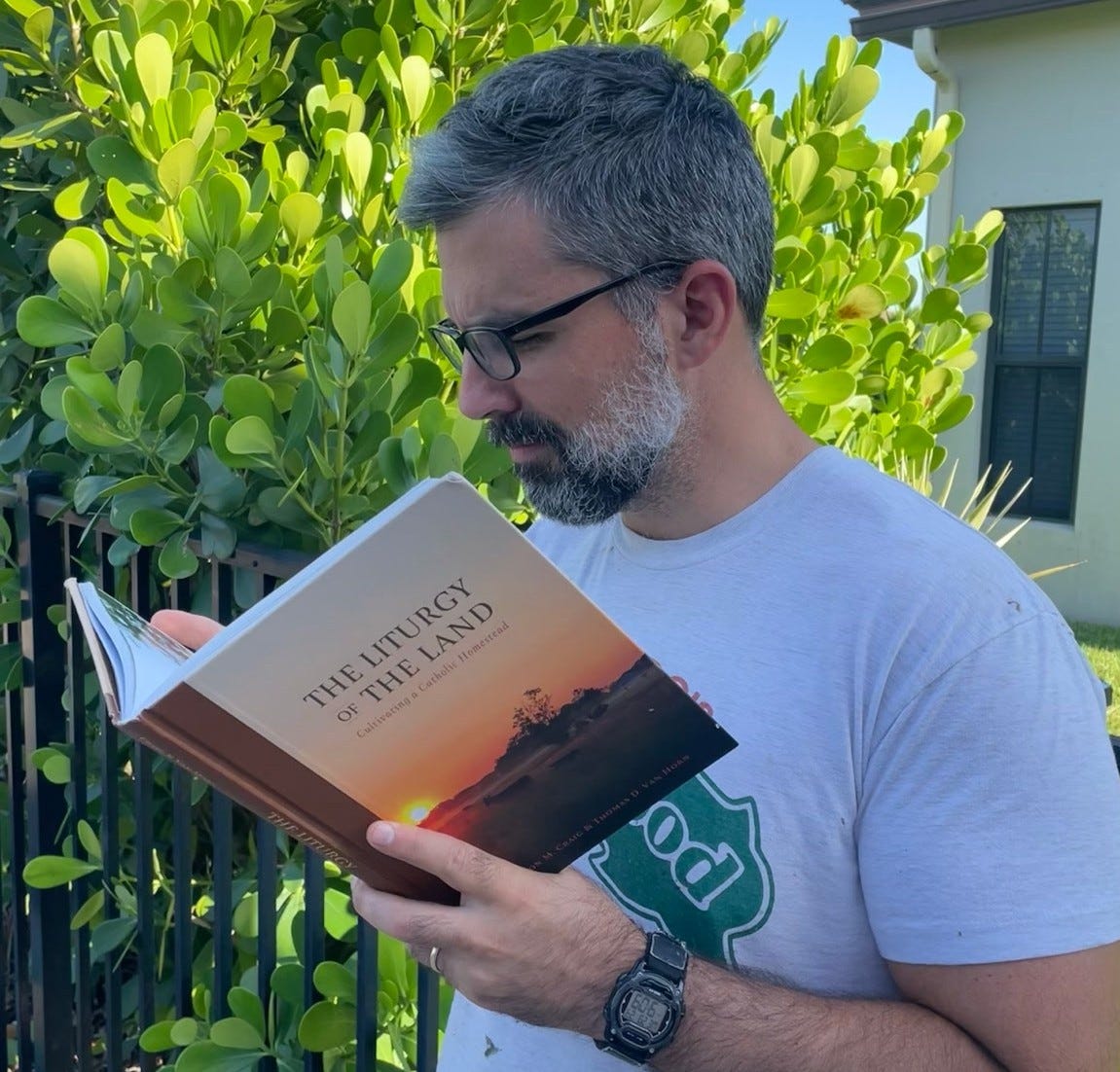
This summer is, sadly, coming to an end, and with it my grandiose hopes of reading several dozen books. But I did finish one: Liturgy of the Land: Cultivating a Catholic Homestead. Reading such a book may seem improper for someone like me, who lives on 1/20 of an acre in a “master-planned community.” There are no cows on our tiny parcels. (Though, a renegade friend of mine did keep bees until a bear helped himself to the hive). So why read it? Among other reasons, I am convinced that the most viable politics, especially at present, is a local politics, one that will inevitably have something to do with food and land and family and place. Thus, I want to briefly explain why this book is worth reading and what I enjoyed most about it.
A Book of Contrasts
Liturgy of the Land was published in 2023 by TAN Books. Its authors, Jason Craig and Thomas Van Horn, are both farmers and Catholics. The former is a dairy farmer, while the latter harvests honey. Craig also runs Sword and Spade, a podcast and magazine, and he helped put together a very interesting series of essays in The American Catholic Land Movement, also published by TAN Books, which I have been picking through.
The chapters in Liturgy of the Land are arranged in a series of contrasts, with the goal being to help you, the reader, to see the difference between life off the land versus life on the land: from the division of labor to integration, from mechanical time to seasons, from wages to productive property, and so on. The book pits what we currently have—alienating work, fragmented families, life lived in mechanical time—with what we could have: integrated work and families lived in organic time, in harmony with the seasons. It is filled with high-quality photographs and an appendix of possible homestead activities that you could undertake in terms of the costs and benefits to a family. The book runs 257 pages, but the photographs, appendix, and engaging style make it a quicker read.
Theory and Practice
The book is unique insofar as it blends theory and practice. We have perhaps never before been glutted with so much “useful content” on YouTube, DIY blogs, and now AI.1 But the genius of Liturgy of the Land is that it situates what is perhaps one of the most useful of all branches of knowledge—agriculture—within a larger narrative of economic decline and alienation that has occurred in the past century or so. Rare is the book that can really connect to a larger story of why some practice is worth pursuing (as opposed to others). In it, you learn about the overarching transition we made as Americans from cottage industry to wage earners. Responding to the criticism that they want to “go back” to the past, an impossible and Romantic endeavor, the authors write,
Catholic historian and scholar Alan C. Carlson helps show that families, especially in the United States, did not ‘leave’ the land at all but have been moved from it by policy and practice. If it is something artificially imposed on the family, especially if it has had a traceably negative effect, then there are stronger arguments to push back and do our best to ‘go back.’ Carlson’s work has shown that suburban developments have been an intentional objective of government housing policy for close to a century, and these policies had explicit goals to increase urban populations with the obvious and intentional side effect of depleting the countryside of its farmers. The ‘suburban experiment,’ as Carlson calls it, refers to homes being built in a fashion foreseeing that they would not be places of production but of consumption.
They continue with some more specific historical details,
As an example of these policies that preferred suburbanization, we can consider that almost all homes in the United States once housed spaces for work, food preparation and storage (like cellars), and often even room enough for multiple generations. But in the middle and later 1900s, official policies put us on a different course. For example, mortgage guidelines from the FHA ‘were systematically denied to any residence that contained facilities designed for use as a productive shop, office, or separate apartment for an extended family member or renter, or preschool,’ explains Carlson. The government wanted to phase out rural and productive homes in favor of consolidated suburban neighborhoods as a necessary part of a consumer-based, industrial economy.
And finally,
There is a logic to the government preferring non-productive, suburban homes. Productive homes, like homesteads, remove people from the workforce, reduce the need to purchase new products (consume industrially manufactured goods), and do not generate taxable income nor contribute to the revenue from various sales taxes. (17-18)
Thus, you can begin to see some of the political implications behind homesteading, land use, and food production. If I were to drive down the street, I’d see tomato and citrus fields getting torn up for the latest copy-and-paste “lifestyle community.” It is important to know that governments, corporate entities, and political actors actively intervened to help usher in massive changes that transformed us into mere consumers. And, more importantly, they’re still intervening.
From Consumers to Participants
Altogether, perhaps what I like most about this book is that it helps shift your mindset away from consumption and towards participation. You are not a mere Cartesian spectator over against a world of objects. You live in the Cosmos. You are a participant in being, in that which is, in that which lives and moves and grows alongside you. Nature is not something over against you. Rather, it is something you’re in that (at least partially) helps constitute who you are.
While the book primarily addresses those who want to make productive use of the land they live on, those who to go “from here to there,” the authors don’t suppose everyone can do it, whether for financial or practical reasons (25). The chapter “Discerning a Place Between Suburbia and The Village” is especially appropriate in this regard. The authors write,
…we place before us the word ‘suburban’ home not as a slur or degradation but as an observation of the predominant arrangements for most households in our country. And, relatedly, this is very often the thing that people are moving away from in a desire to move toward a homestead. This shows that, for many, the urging toward a homestead is not necessarily a romantic and impractical idealizing of a bygone era but an essentially practical reorientation of the home as an economy unity, remembering again that the original meaning of the word “economy” [oikonomia] is household management. We are reconceiving not just how we think of a home but what a home is for. We who are, in a sense, converting our homes to this different arrangement must recognize that between suburbia and a community of homesteads is a spectrum of arrangements, and making a move on that spectrum can be subtle but fruitful or it can be an entire and total change of culture. (153)
So maybe you’ll never have three acres and a cow, G. K. Chesterton’s prescription for what you’d need for a productive household. But maybe you could do something subversive like start a garden. Maybe you could put some tomatoes in a grow bag on that apartment balcony of yours. By so doing, you might come to a realization of the inherent fecundity of nature. Seeds grow of their own accord. You might even make the analogical leap between the natural and supernatural:
This is how it is with the kingdom of God; it is as if a man were to scatter seed on the land and would sleep and rise night and day and the seed would sprout and grow, he knows not how. Of its own accord the land yields fruit, first the blade, then the ear, then the full grain in the ear. And when the grain is ripe, he wields the sickle at once, for the harvest has come. (Mark 4:26-29)
There’s a majesty in the natural order of things that our alienated modes of existence hide from us. Growing just one plant of your own is perhaps all you need to realize the inherent insanity and maliciousness of a company that produces seeds that go sterile after the first generation.2 We lose something economic when we lose the land, it is true. We lose real political sovereignty, whether we realize it or not. But we lose also that natural context from which spring some of the most extraordinary metaphors from Scripture: the faith the size of a mustard seed, the grain of wheat that falls in the ground, the fig tree that teaches.
Everyone grows something in their driveway or yard, whether they want to or not, even if it is a weed or some grass. Whatever it is, why not help it along? You don’t necessarily need to take pictures of what you’re growing and float them into cyberspace. Just let your neighbors see. You may alarm them. Or you may inspire them. After all, there’s a widespread movement to go and “touch grass” nowadays. If you don’t like grass, why not plant something in its place? A fig tree, perhaps?
If you liked this post, you might also like:
I suppose you may be surprised to hear me describe AI (LLMs) as useful. AI does have heuristic merit in practical contexts, especially when you’re trying to fix something in your house through trial and error, for example, and you don’t want to have to browse the 1,000 ad-filled DIY blogs that have taken root in the past twenty years.