

Remember, You Die
Three ways to place your end before you

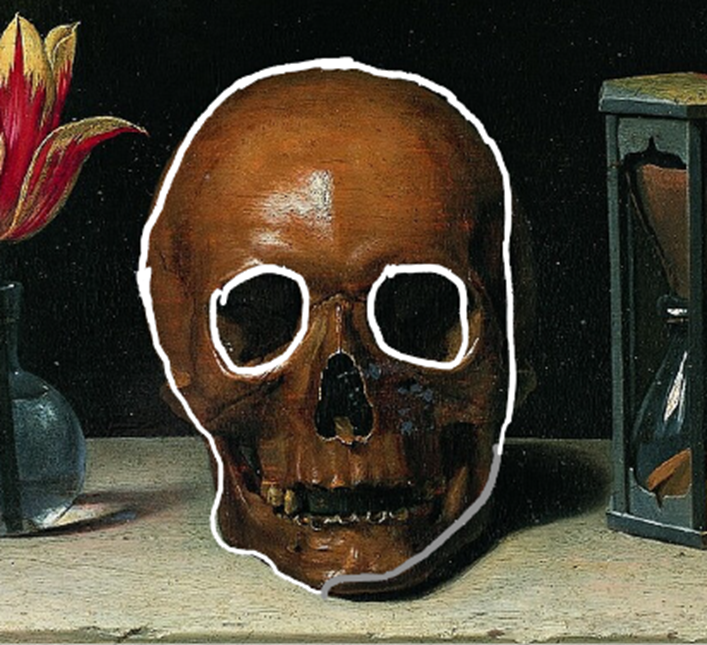
In Tolstoy’s “The Death of Ivan Illich,” the main character has a lapel pin that reads respice finem. The English translation of this phrase is, “Look to the end.” Otherwise put: Remember, you die.
What is so ironic about this little lapel pin is that Ivan Illich does not look to his end (his death), and thus the ultimate meaning of his life gets lost on him when he falls gravely ill later in the tale. What’s the lesson? We ought to repeatedly reflect on our own death, which might give us a greater appreciation for the vanity of the things of this world. It might also make us more sympathetic to our shared lot with others—friends and strangers alike—who must ultimately pass from this world, too.
In life, nothing is certain except that at some undisclosed time and in some unknown place, you will die.
What is so odd (and remarkable) about death is that we must remember it, which is to say that we have to remember something that hasn’t happened yet. Remembering our death is perhaps the original existentialist problematic (William Barrett highlights Tolstoy’s influence on Heidegger in Irrational Man). For this little essay, I want to focus on three ways to keep respice finem fresh and top of mind. Some of these ways may sound odd. But what have you got to lose from trying them out? Your life?
#1: Archival Photos
On this Substack, I’ve regularly used archival photos from Flickr Commons in my posts. What’s so amazing about these pictures is how young, fresh, lithe, and beautiful these people look.
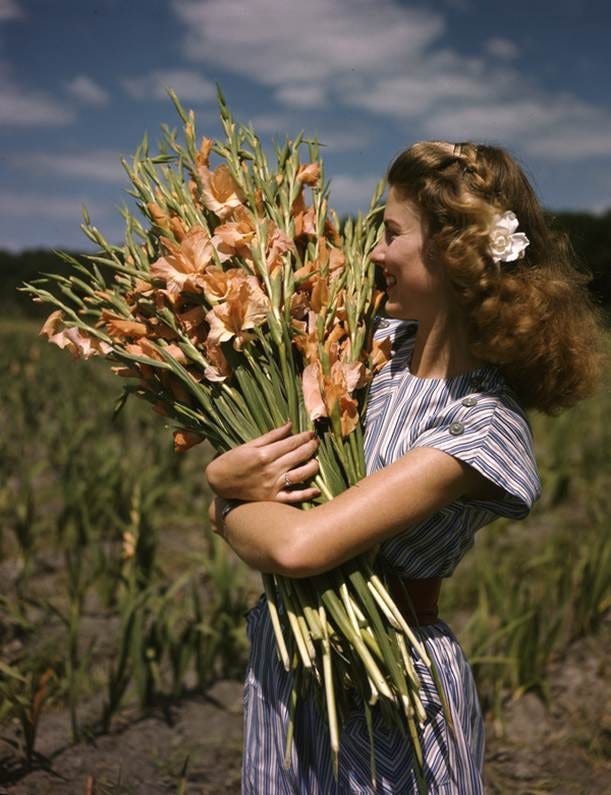
Unidentified woman holding gladiolus
at Terra Ceia Island Farms, Florida | May 8, 1947
As you browse the archive, you notice a trapeze swinger in the 1920s. A man and his son on a beach in the 40s. Another waits for a train at the turn of the century, with a crisp hat and suit and handsome face. And where are they now? Pushing daises, of course. As Susan Sontag writes in her essay, “In Plato’s Cave,”
“All photographs are memento mori” (15).
She explains,
“To take a photograph is to participate in another person’s (or thing’s) mortality, vulnerability, mutability. Precisely by slicing out this moment and freezing it, all photographs testify to time’s relentless melt” (15).
As Gollum says in his riddle concerning time in The Hobbit:
This thing all things devours:
Birds, beasts, trees, flowers;
Gnaws iron, bites steel;
Grinds hard stones to meal;
Slays king, ruins town,
And beats high mountain down.
Photos catch the movement of time by arresting it. There’s something about the affective immediacy of an image that burns itself into your memory. The old commonplace from painting was to use a skull to signify the vanity of life. For me, at least, Baldung’s The Ages and Death is one of the most effective paintings ever created for directing the viewer’s attention to death.1
Nevertheless, I suppose the tactic of looking at old photographs may not work for everyone. So let us consider another way of impressing death into our minds.
#2: Counting the Days
When you’re young, 20 years feels like forever. When you’re middle aged, 20 years feels like nothing. I remember being 18. My back didn’t randomly hurt. Each birthday seemed to celebrate my youth. But what does a year feel like, nowadays? It feels like nothing. The rationalists and utilitarians and bean counters out there might say that the year is a bad metric for measuring death. For once, I would agree with them.
Thus, I propose to translate your years (potentially) remaining into days to give greater urgency to each day. I think a year imperceptible. Not so a day.
Let’s say you’re 35. Let’s say that, barring a fatal car accident, cancer, terrorist attack, etc., you’ll live until you’re 85. 50 years seems like a long time, doesn’t it? 50 years is 18,250 days. That, too, may seem very long. (Or maybe not? Do all those days seem more real than 50 years?)
In any case, consider this. If you’re 35, you’ve already lived 12,775 days. By tomorrow, you’ll have 18,249 days left (if you live to 85). And thus, by a slow drip of days, your vitality will leave you. Wrinkles will appear on your face. Friends will fade (lost to accident, cancer, etc.). And rust and moth will come to do their jobs, as they always do.
If this conversion of potential years remaining doesn’t work for you, you can try a few things:
Return to #1: Archival Photos.
Estimate 20-30 years instead of 50 to hedge for disease, accident, etc. (7,300 to 10,950 days).
Read some obituaries, especially of the “young,” whether “young” means 40 or 65 to you. You’ll find plenty of people in those obituary pages. If you can’t see yourself in them, my question is: Why not? Is death something that only happens to other people?
#3: Read Some Meditations
Here are just three works to read that might stir some fire in your soul.
1. St. Francis De Sales’ Introduction to the Devout Life. De Sales’ meditation on death appears amidst his others on judgment, heaven, and hell. Imagine, the saint tells us, the day and the hour. Will it be sudden or slow? Consider how quickly you’ll be forgotten (because you, too, will become a sign of others’ finitude). Read the whole thing here.
2. Petrarch’s Secretum. St. Augustine appears to Petrarch to set him on the straight and narrow in this classic dialogue. In the dialogue, Augustine insists that the first step in overcoming the distresses of this mortal life is constant meditation on death and human misery. Petrarch has Augustine say:
“No man is so senseless (unless he be altogether out of his mind) as never once to remember his own weak nature, or who, if asked the question whether he were mortal and dwelt in a frail body, would not answer that he was. The pains of the body, the onsets of fever, attest the fact; and whom has the favour of Heaven made exempt? Moreover, your friends are carried out to their burial before your eyes; and this fills the soul with dread. When one goes to the graveside of some friend of one’s own age one is forced to tremble at another’s fall and to begin feeling uneasy for oneself; just as when you see your neighbour’s roof on fire, you cannot fool [sic] quite happy for your own, because, as Horace puts it—
“On your own head you see the stroke will fall.”[7]
The impression will be more strong in case you see some sudden death carry off one younger, more vigorous, finer looking than yourself. In such an event a man will say, “This one seemed to live secure, and yet he is snatched off. His youth, his beauty, his strength have brought him no help. What God or what magician has promised me any surer warrant of security? Verily, I too am mortal.”
When the like fate befalls kings and rulers of the earth, people of great might and such as are regarded with awe, those who see it are struck with more dread, are more shaken with alarm; they are amazed when they behold a sudden terror, or perchance hours of intense agony seize on one who was wont to strike terror into others. From what other cause proceed the doings of people who seem beside themselves upon the death of men in highest place, such as, to take an instance from history, the many things of this kind that, as you have related, were done at the funeral of Julius Cæsar? A public spectacle like this strikes the attention and touches the heart of mortal men; and what then they see in the case of another is brought home as pertaining also to themselves. Beside all these, are there not the rage of savage boasts, and of men, and the furious madness of war? Are there not the falls of those great buildings which, as some one neatly says, are first the safeguards, then the sepulchres of men? Are there not malignant motions of the air beneath some evil star and pestilential sky? And so many perils on sea and land that, look wheresoever you will, you cannot turn your gaze anywhither but you will meet the visible image and memento of your own mortality.”
3. Tolstoy, “The Death of Ivan Illich.” Well, we’ve come full circle, haven’t we? This tale begins with Ivan’s funeral and then rehearses how Ivan made his way to his grave: his conventional life, his vain desires, his death grip on this life. Read it here.
Morbid or Necessary?
What is the upshot of all this reflection on death? It is only this: to put the things of this life in their proper perspective. Contemplation of your death is a sobering, wonder-inspiring act. You will die. It is absolutely certain. Crafty creatures that we are, we constantly deceive ourselves into forgetting our end. And we congratulate ourselves into thinking we’re not morbid! We think by deferring the very thought of death we can defer the very thing itself. But that’s impossible. Imagine the fruit you’ll bear by consistently reflecting on your finitude. Each day will become infinitely important. Death won’t catch you by surprise. You’ll have trimmed your wick (Mt 25:1-13). You’ll be ready, loins girt, to leap into the great beyond where time is no more.
With your end in mind, you’ll be better able to see how vain and unprofitable much of social media is, how ridiculous it is to spend any more than a fraction of a second on the Internet (let alone doomscrolling your life away). One of Anton Barba-Kay’s great insights is that digital technology becomes an instrument of death insofar as it causes us to forget our own death.
Everyone is called to be a good steward of his or her days. As with your money and the hairs on your head, your days, too, are numbered. But do you really know it? What have you done so as to prevent this certain truth from slipping into oblivion? What will you do?
In terms of capturing the passage of time, compare Baldung’s painting to the music video for “Postcard from 1952” by Explosions in the Sky.